Chainle Strategy: Compare Clues to Find Better Connections
Put a tower and a tree side by side, and height is an obvious comparison. But it is only one of several possible relationships. Both can cast a shadow, serve as landmarks, or stand above their surroundings.
Chainle asks you to explore that second kind of comparison. Instead of deciding which object is taller, you choose one word that connects the clues in meaning.
Chainle is a five-round word connection game with one valid guess per round. The challenge is to notice a relationship that works across every clue, then learn from the score and chains the game reveals.
For readers who enjoy seeing things side by side, a small comparison table can make the thinking process clearer. Here is how to use one without mistaking your own reasoning for the game's scoring formula.
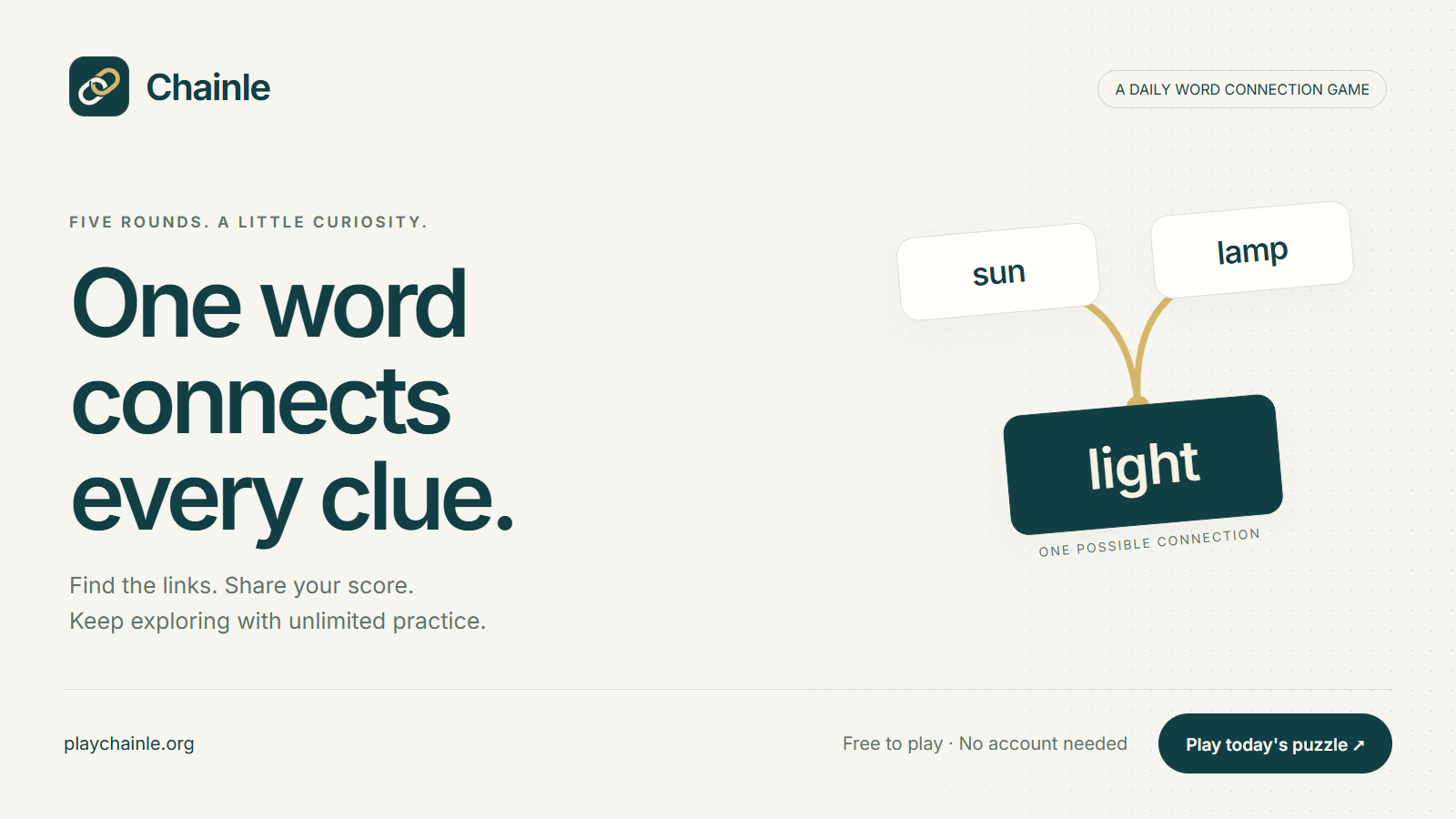
Image: Chainle. The diagram illustrates a shared relationship, not a measured distance or a live puzzle answer.
What are you comparing in Chainle?
The Chainle game asks for one English word related to the clues on screen. It is free to play in a browser, with no account or app installation required.
Think of it as a word association game in which every candidate needs more than one explanation. If the clues are tower and tree, “elevator” might fit one side while “leaf” fits the other. Neither creates an equally clear relationship across the pair.
“Height” gives you a possible shared property. “Shadow” gives you a different relationship. Both are reasonable ideas to consider before you know how the game will score them.
These are illustrative clues and candidates, not confirmed Chainle solutions. The point is to expose your reasoning rather than invent a numerical result.
In a height comparison, the unit and measurement method provide the basis for comparison. In Chainle, you first need to identify the relationship: function, material, category, action, or another sense of a word.
How the five-round Chainle game works
The first three Chainle rounds each show two clues. Round four shows three. The final round shows one clue and asks for a close connection in meaning.
For each round, type one supported English word and select Connect, or press Enter. Once the game accepts and scores it, review the feedback and continue. There is no timer.
Every round offers up to 1,000 points, with a maximum of 5,000 across the session. More than one playable answer can earn full points; the revealed reference connection is not an exclusive password you must reproduce.
A rejected word is different from a low-scoring word. Invalid entries do not use your turn, while an accepted guess settles that round. The comparison exercise below should happen before you submit.
Make a comparison table for your candidates
Consider camera and eye. Both suggest seeing, but there are several ways to describe the relationship.
| Candidate | Connection to camera | Connection to eye | Question to ask |
|---|---|---|---|
| Tripod | Supports a camera | No obvious everyday connection | Am I only solving one clue? |
| Eyelid | No obvious camera component | Covers an eye | Have I simply switched sides? |
| Lens | An optical component | An optical component | Does the same explanation reach both? |
| Focus | Adjusting image sharpness | Directing or adjusting vision | Is a shared action useful here? |
This table is a reasoning aid. Its entries are not measured similarity values, and none is a promise of a particular Chainle score.
The advantage is that weak links become visible. Without writing them down, you might spend a long time defending “tripod” because its relationship to camera feels so strong. The empty second explanation exposes the problem immediately.
You can use the same method in any word connection game that asks for a shared idea. Make one column per clue, then check whether each candidate has a simple explanation in every column.
For a short daily puzzle, you do not need a spreadsheet. Two or three candidates on a scrap of paper are enough.
Compare different relationships, not just different words
If every candidate comes from the same narrow association, your list may not help. Try changing the kind of comparison.
For umbrella and roof, think about function: both can provide shelter. For sponge and towel, consider the action absorb. For ladder and mountain, explore the action climb.
These examples explain ways to think; they are not live Chainle answers. Their useful feature is that each pair gives you a relationship you can name in ordinary language.
A word association game also invites you to reconsider a clue's meaning. An everyday word might describe an object in one context and an action in another. Before rejecting a candidate, ask whether you have fixed the clue to only one interpretation.
Readers who use CompareHeights can treat this as a change of question. A height chart makes relative size visible. A clue table makes your explanations visible. Both benefit from deciding what you are comparing before deciding what the comparison means.
The analogy has a limit: semantic relationships are not centimeters. A taller bar would not make a word “more related” unless you had meaningful data behind that bar. Use words such as “clear,” “strained,” and “uncertain” for your own notes instead of inventing similarity percentages.
Read your Chainle game score without overreading it
Chainle evaluates the relationship with each clue. That means a strong connection on one side can coexist with a disappointing overall result.
In a two-clue round, if one connection is zero under the scoring system, the result is zero even when the other connection is strong. In the three-clue round, the weakest connection receives some help in the calculation, but you still have a reason to inspect all three clues.
Each visible chain has up to eight links. Those links are rounded indicators; the points use more precise strengths. Similar-looking chains can therefore produce different totals, and a full-looking display is not a guarantee of exactly 1,000 points.
This is particularly useful to remember if you like visual comparisons. The picture gives a quick impression, while the score preserves distinctions the picture may hide.
A word rank is another separate comparison. It places an answer among eligible words for that round; it is not the number of players you beat.
In a word association game, the result also has interpretive limits. An uncommon sense, a personal memory, or a clever joke may explain your choice without being strongly represented in the game's scoring. Review the feedback, but do not treat the number as an objective rating of your imagination.
Adjust your method for three clues and one clue
Round four is where a two-column habit needs an extra check. A candidate might explain the first two clues beautifully while barely touching the third.
Add the third column before choosing. If its explanation is vague, ask whether a broader function or category can include all three. Avoid broadening so far that the candidate could describe almost anything: “thing” does not become insightful merely because it covers every object.
The last Chainle round requires a different adjustment. With one clue, you no longer need a bridge between separate ideas. Look for a nearby meaning or close conceptual neighbor, and consider whether a candidate merely appears in the same setting.
That distinction keeps a useful strategy from becoming a rigid rule. A word connection game changes when the number of clues changes; your question should change with it.
Use practice to compare decisions fairly
The daily Chainle puzzle gives players the same five-round set for the same date on this site. It resets at 00:00 UTC. Unlimited mode provides additional sessions, and the archive provides available earlier dates.
Choose a mode based on what you want to compare:
- Daily: Discuss the same five decisions with a friend after both finish.
- Unlimited: Practice checking candidates without waiting for another daily puzzle.
- Archive or replay: Revisit an available puzzle and examine a different interpretation.
Unlimited draws from a finite collection, so repeated clues are possible. Replaying a completed daily puzzle does not replace the first recorded daily score.
To try the method, open Chainle and spend one practice session writing a short explanation for every clue. After each reveal, note whether the weakest chain matches the explanation you found hardest to write.
Do not treat a higher score on an easier or different puzzle as proof that the method improved your performance. A more useful observation is whether you noticed a weak relationship before submitting.
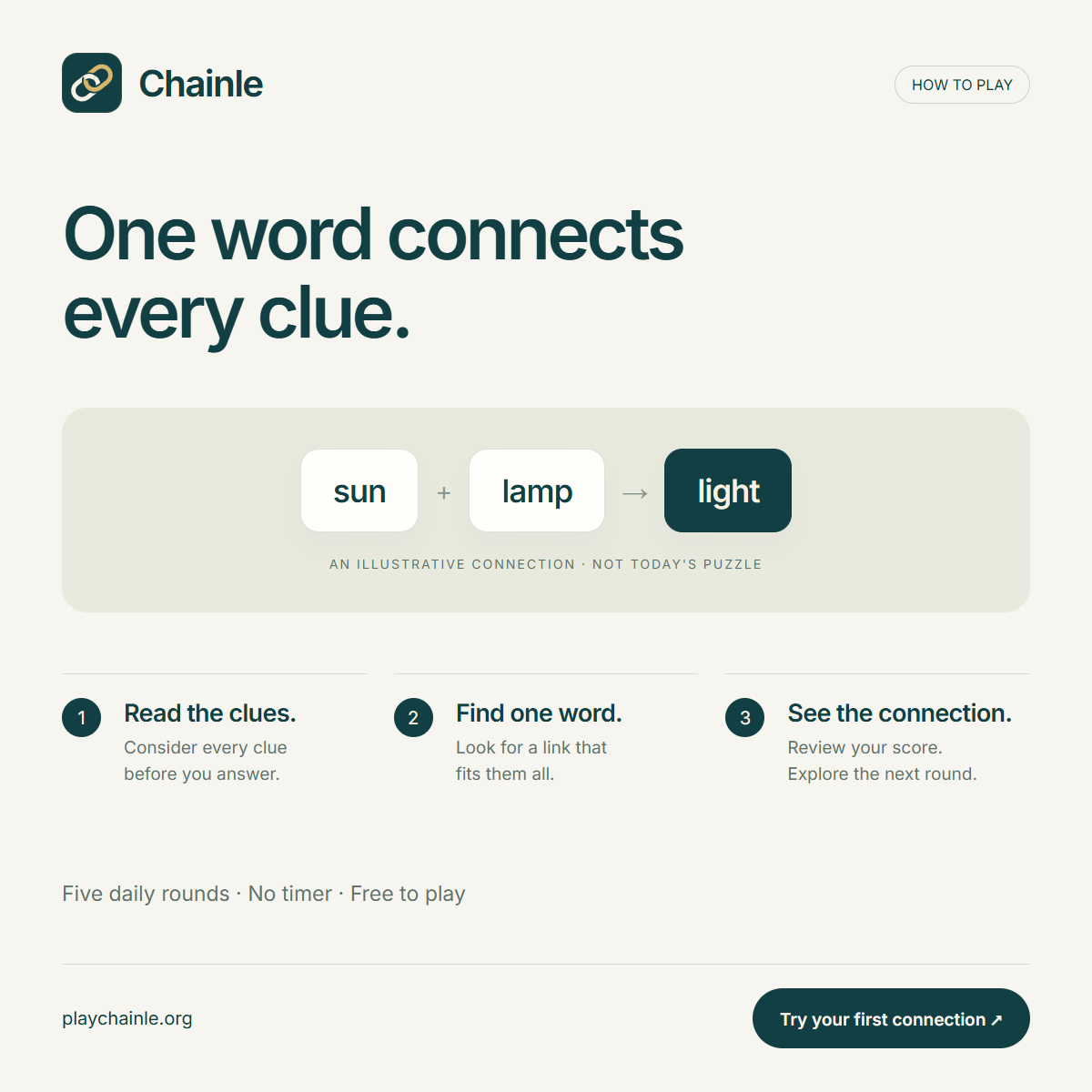
Image: Chainle. Review each connection separately before moving to the next round.
Common Chainle game questions
Why does the game reject a real word?
Chainle has a finite playable vocabulary. Enter one English word using letters, and avoid a clue or a prohibited close variant. The message distinguishes an invalid entry from an accepted answer; rejection does not use your turn.
Can I see an answer without reading a whole solution page?
After a valid submission, the round reveal lets you inspect a strongest link. If you consult a dated guide, check that its clues match your puzzle before reading further.
Can I resume my Chainle game on another device?
Progress belongs to the current browser. There is no automatic account-based syncing across devices, and clearing site data can remove access to saved progress.
How should I share a result?
Choose the spoiler-free result and check its preview. Compare the same puzzle date, and keep guesses out of the conversation until everyone has played.
The next time a Chainle clue seems obvious, look at the other column. A useful answer should survive the comparison.
Related resources
- Chainle introduction and playing guide on Google Sites — an overview of the round formats, connection strategies, and result feedback.